How to choose between car chargers and travel chargers is not merely a question of plug shape. It is about matching power, ports, and portability to the places you actually charge. A car charger fits a vehicle’s 12-volt outlet and is useful on the road. A travel charger plugs into a wall outlet, often with interchangeable plugs or multiple ports. Some dual-purpose models do both, but check the specifications carefully.
The USB Implementers Forum’s USB Power Delivery 3.1 specification allows power levels up to 240 watts. That is a technical ceiling, not a promise that every charger, cable, or phone supports that output. A practical paraphrase of USB-IF President Jeff Ravencraft’s guidance on USB-C is: “One connector can serve many devices, but compatibility still matters.” Check the device’s supported charging standard, the adapter’s rated output, and the cable’s capacity before buying.
For context, the International Energy Agency’s Global EV Outlook 2024 reported that public charging points for electric vehicles grew by more than 40% in 2023. That figure describes EV infrastructure, not USB car chargers, so it should not be used to predict phone-charger performance. Still, it underscores how quickly charging environments are changing. On a long drive, a compact car charger can keep a navigation phone powered; in a hotel room, a travel charger with two USB-C ports may reduce outlet juggling. Small details count.
Compare heat management, safety certification, cable fit, and real-world output—not just advertised wattage. A higher number is not always better. The honest choice depends on your devices, travel habits, and available outlets.
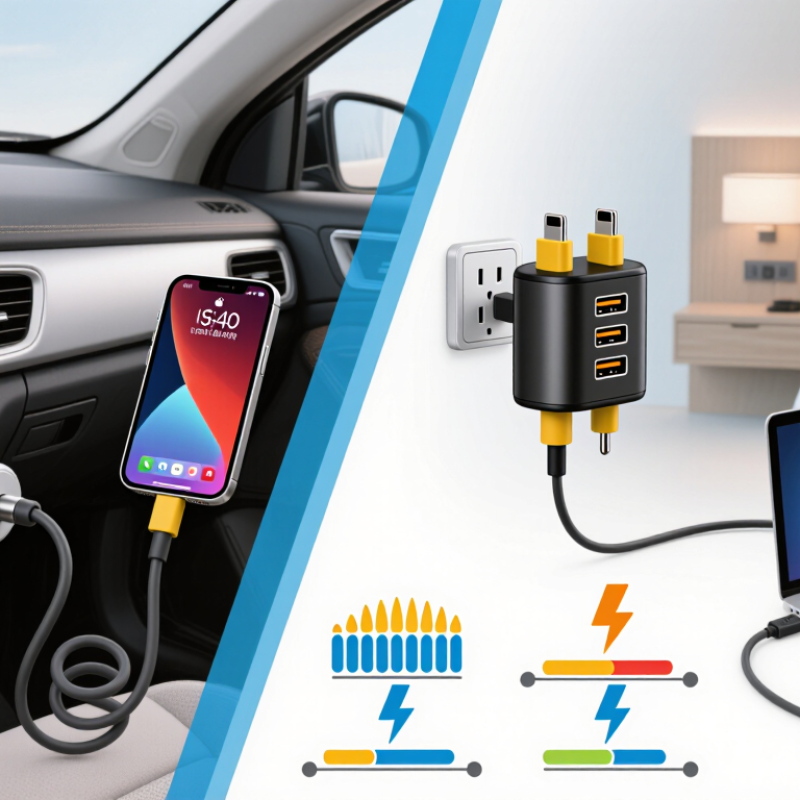
Car chargers and travel chargers solve different problems. A car charger draws power from a vehicle’s 12-volt socket or built-in USB port. A travel charger plugs into a wall outlet. The first suits a commute; the second is useful beside a hotel bed. Neither is automatically faster. Check the output wattage and your device’s supported charging standard before buying.
For a useful benchmark, the USB Implementers Forum’s USB Power Delivery 3.1 specification allows up to 240 watts over USB-C. That is a standard’s maximum, not the power every charger or phone provides. In practice, your device, cable, and charger must all support compatible power levels. A compact wall charger may also need a separate plug adapter abroad; an adapter alone does not convert charging power. Small detail, big difference.
Tips: Match the charger’s output to your device, and check the vehicle port’s rating. Keep a short cable in the car and a wall charger in your travel bag. I still find labels confusing sometimes, so verify the fine print before a trip.
| Comparison point | Car charger | Travel charger | What to consider |
|---|---|---|---|
| Power source | Plugs into a vehicle’s 12 V accessory socket; some vehicles also provide 24 V sockets. | Plugs into an AC wall outlet. Many USB wall chargers accept 100–240 V AC at 50/60 Hz, but check the product label. | Confirm the charger’s input rating matches the available power source. |
| Best suited for | Charging devices during drives, commutes, and road trips. | Charging from wall outlets at home, hotels, airports, and other locations with compatible sockets. | Choose based on where you expect to have access to power. |
| Charging output | Output varies by model and port. USB-C Power Delivery and USB-A charging are available on many models. | Output varies by model and port. USB-C Power Delivery and USB-A charging are common options. | Check the stated output in watts and the charging protocols supported by your device. |
| Charging speed | Depends on the charger’s output, the vehicle socket, the cable, and the device’s charging limits. | Depends on the charger’s output, the wall outlet, the cable, and the device’s charging limits. | A higher wattage rating does not guarantee faster charging if the device or cable cannot use it. |
| Ports and simultaneous charging | Available with one or more USB ports; total output may be shared when multiple devices are connected. | Available with one or more USB ports; total output may be shared when multiple devices are connected. | Check both the per-port output and the total output when charging several devices. |
| International travel | Useful in a compatible vehicle, but it does not plug directly into a wall outlet. | A dual-voltage AC charger can work with different mains voltages when its input label covers them; a plug adapter may still be needed. | A plug adapter changes plug shape; it does not convert voltage. Verify the charger’s input rating and local plug type. |
| Portability and setup | Compact for a vehicle, but requires an accessible accessory socket and a suitable cable. | Typically easy to pack; requires a compatible AC outlet and, in some destinations, a plug adapter. | Consider the charger’s size, cable arrangement, and the outlets available at your destination. |
| Safety and compatibility | Use a charger designed for the vehicle socket and follow the vehicle and charger instructions. | Use a charger rated for the local AC supply and follow its instructions. | Use undamaged cables and equipment with appropriate safety certifications for the market where it is sold. |
| Quick choice | Choose one for charging from a vehicle’s accessory socket while on the road. | Choose one for charging from wall outlets, especially when staying in hotels or traveling internationally. | For frequent driving and trips, carrying both types can cover vehicle and wall-outlet charging needs. |
Specifications vary by model. Check the charger, cable, device, vehicle, and local power requirements before use.
The connector shape does not reveal the power path. A car charger converts vehicle DC, while a travel charger converts wall AC. Check the output profiles.
No. It shows a maximum under certain conditions. Battery level and temperature can reduce charging speed.
They are protocol ceilings for different specification versions, not promises for every device. The charger, cable, and device must support compatible power profiles.
Not always. A multi-port charger may divide power between a laptop and phone. Check both the individual port ratings and shared output.
Check the vehicle manual for socket limits, including fuse and wiring capacity. Confirm the charger suits the socket. Keep cables clear of the driver’s controls.
A plug adapter changes the plug shape, not the voltage range. Check that the charger supports the destination’s voltage.
Check each device’s recommended power input. A phone may need less power than a tablet or laptop. Count the ports you will actually use.
Forgetting a cable, or packing one that cannot support fast charging, can cause trouble. I still forget one sometimes. My checklist is not perfect.
Choosing between car chargers and travel chargers starts with understanding where and how you will use them. Car chargers draw power from a vehicle’s outlet and are designed for charging while driving, while travel chargers plug into wall outlets and suit hotels, offices, and other destinations. Their charging standards and power ratings can affect charging speed and whether they work well with your phone, tablet, or other devices.
To decide what fits your 2026 setup, compare compatibility, portability, and safety features, then consider your devices, vehicle, and typical travel routine. A compact travel charger may be the better everyday choice if you mainly charge indoors, while a car charger is useful for frequent road trips or long commutes. If you regularly switch between both environments, carrying one of each can offer flexibility. How to choose between car chargers and travel chargers ultimately depends on matching the charger’s connections and power output to your devices and choosing a reliable option for each setting.

 Laisen Electronic