The rise of Gallium Nitride (GaN) technology has transformed the charging landscape. In contrast to traditional chargers, GaN chargers promise enhanced efficiency, smaller sizes, and faster charging times. According to a report by MarketsandMarkets, the GaN charger market is expected to reach $1.79 billion by 2025, driven by increasing demand in consumer electronics.
"What is the difference between GaN tech and traditional chargers?" experts in the field, like Dr. Emily Chen, highlight, “GaN technology allows for better thermal management, providing faster charging without overheating.” This innovation is not without its challenges, particularly regarding compatibility with old devices. Users must be cautious while transitioning. GaN chargers can be significantly more compact, but the swift advancements leave some skepticism in the market regarding reliability and adoption rates.
Understanding these differences is crucial for consumers today. It is important to weigh the benefits against potential drawbacks. As the technology evolves, staying informed on what sets GaN apart will help drive smarter purchasing decisions.
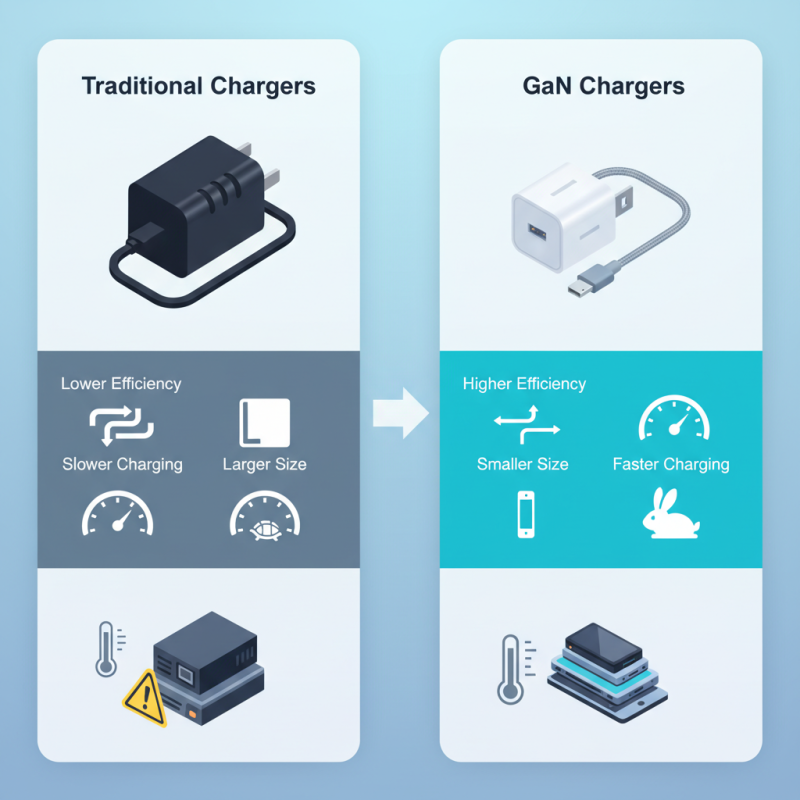
GaN technology, or Gallium Nitride, represents a significant advancement in charger efficiency compared to traditional chargers. With GaN chargers, energy losses during the charging process are dramatically reduced. Traditional chargers typically operate at about 75-80% efficiency. In contrast, GaN chargers often exceed 90% efficiency. This means faster charge times and less wasted energy, which is better for both users and the environment.
One of the most remarkable aspects of GaN chargers is their ability to maintain high efficiency even at high power outputs. Traditional chargers might struggle with heat management when pushed to higher performance levels. This can lead to overheating, energy waste, and potential hazards. GaN’s thermal conductivity allows it to operate cooler, showcasing its effectiveness in various conditions.
However, it's essential to note that while GaN technology is advanced, its adoption can raise questions about compatibility and cost. This creates room for discussion about the trade-offs between initial investment and long-term efficiency gains.
GaN (Gallium Nitride) technology is transforming the charging landscape. One major advantage is its power density. Unlike traditional chargers, GaN chargers are smaller yet more powerful. This allows for compact designs that fit easily into bags or pockets. A GaN charger can deliver the same output power as a traditional charger in a fraction of the size. This is a game changer for travelers and tech enthusiasts alike.
Moreover, GaN chargers generate less heat during operation. Traditional chargers waste energy as heat, requiring larger heat sinks and enclosures. In contrast, GaN technology allows devices to remain cool. This not only maximizes space but also extends the lifespan of the charger. The design challenges are still present. Some users report that smaller chargers may sometimes lack robustness. However, this does not overshadow the benefits of efficient charging. The growing popularity of GaN technology is reshaping our expectations of what a charger can be.
GaN technology has revolutionized charging speeds, outperforming traditional chargers significantly. A recent report from the Power Electronics Research Group highlights that GaN chargers can deliver power levels up to 60% faster than conventional silicon-based options. This leads to shorter charging times for devices, a crucial factor for today’s fast-paced lifestyle.
For instance, while a traditional charger may take over four hours to fully charge a laptop, a GaN charger can achieve this in under two hours. This contrast is evident in electric vehicles as well. GaN technology can facilitate rapid charging in just 30 minutes compared to the 90 minutes often required by standard chargers. Efficiency metrics indicate that GaN achieves over 90% efficiency with less heat generated, making it reliable for daily use.
However, using GaN chargers doesn't come without challenges. Initial costs can be higher, and some users may face compatibility issues with older devices. Additionally, understanding the specific power ratings and requirements of devices can be complex. The rapid evolution of charging technologies necessitates consumer awareness and adaptation. Industry experts suggest continuous education to ensure optimal usage of these advanced chargers.
Thermal management is crucial in understanding GaN technology compared to traditional chargers. GaN, or Gallium Nitride, generates less heat than legacy silicon-based chargers. This efficiency results in faster charging without the heat buildup that often plagues older designs. Many users may not be aware that excessive heat can reduce the lifespan of electronic devices.
In contrast, traditional chargers often struggle with heat dissipation. They tend to generate significant heat, especially with prolonged use. This heat can lead to inefficiencies and even safety concerns. Users might notice their devices getting warm, but they may not realize the potential long-term effects on battery health. The increased heat can cause thermal throttling in devices, slowing down performance when charging.
GaN chargers provide a more reliable energy transfer. They utilize advanced materials that efficiently convert power without excessive heat loss. However, while many GaN chargers effectively manage heat, not all designs are created equally. Some may experience thermal issues under heavy loads. It is essential for users to choose high-quality products and understand their thermal performance. Investing in reliable charging solutions can significantly enhance device longevity and overall user satisfaction.
The shift from traditional chargers to GaN (gallium nitride) technology represents a significant development in the charging industry. GaN chargers are compact and efficient, allowing for faster charging times. Reports indicate that GaN technology can reduce charging time by up to 70%, making it an attractive solution for consumers on the go. However, initial costs can be higher compared to traditional silicon-based chargers.
Cost analysis shows that while GaN chargers may have a higher purchase price, their longevity and efficiency lead to long-term savings. Industry studies suggest that GaN chargers have a lifespan exceeding 10 years, while traditional chargers typically last around 3-5 years. The energy efficiency of GaN technology translates to lower electricity bills. A study by the Department of Energy highlights that GaN chargers waste around 30% less energy compared to their traditional counterparts.
Despite these advantages, potential buyers should consider their charging needs and usage patterns. If one primarily uses chargers intermittently, investing in GaN might not yield immediate returns. Additionally, not all devices benefit equally from GaN technology. Users need to assess whether their devices support the technology fully. This reflects the importance of informed decision-making when transitioning to new charging solutions.
: GaN stands for Gallium Nitride, improving charger efficiency significantly compared to traditional options.
GaN chargers often exceed 90% efficiency, unlike traditional chargers, which function at 75-80% efficiency.
GaN chargers produce less heat, minimizing energy waste and lowering the risk of overheating during charging.
Yes, GaN technology operates effectively even at high power outputs without significant heat struggles.
Initial costs are higher for GaN chargers, but their efficiency can lead to long-term savings on electricity bills.
GaN chargers can exceed 10 years in lifespan, while traditional chargers usually last around 3-5 years.
Power density refers to GaN chargers being smaller yet more powerful, perfect for portability and efficiency.
Some users note that smaller GaN chargers may lack robustness, which is something to keep in mind.
Consider your usage patterns; if used intermittently, it may not provide immediate benefits.
Not all devices support GaN technology, so users should check compatibility for optimal performance.
This article analyzes the key distinctions between GaN technology and traditional chargers, answering the question, "What is the difference between GaN tech and traditional chargers?" GaN chargers boast higher efficiency ratings, enabling them to convert energy more effectively and reduce wasted power. Additionally, their superior power density allows for more compact designs, maximizing space usage without compromising performance.
Charging speed is another critical factor, as GaN technology significantly accelerates charging times compared to conventional standards. Moreover, GaN chargers exhibit enhanced thermal management, generating less heat and improving overall safety during operation. Finally, the cost analysis highlights that while the initial investment in GaN may be higher, the long-term savings and benefits outweigh the costs, making them a wise choice for modern charging solutions.

Laisen Electronic